

The Climate of Ghana
Understanding the Ghana Climate Atlas
Climate change is increasingly affecting Ghana through rising temperatures, higher sea levels, and more frequent extreme events like droughts, floods, wildfires, and coastal erosion.
The Ghana Climate Atlas is a vital tool designed to provide reliable information that enhances Ghana’s preparedness and capacity to plan for a sustainable future, adapt to changes, and manage climate risks. Through the Atlas, users can:
- Access detailed Reports for in-depth climate analysis.
- Explore an interactive Mapviewer to see how climate changes over time and across different administrative level.
- Request for datasets to support further research and planning.
- Explore Story Maps featuring case studies of climate change impacts in Ghana.
- Browse our FAQs for concise answers to common questions.
Observed Climate Trends
Historical Climate Patterns in Ghana
Ghana, located between latitudes 4°N–12°N and longitudes 1.5°E–3.5°W, has a tropical climate modulated by the movement of the Intertropical Discontinuity (ITD), which drives distinct wet and dry seasons.
The wet season is influenced by moist South westerly (SW) winds and exhibits a bimodal rainfall pattern in southern Ghana and a unimodal pattern in the north.
In contrast, the dry season is dominated by North easterly (NE) winds, bringing dry and dusty conditions across the country. Temperature patterns are also seasonal, with peak temperatures typically occurring in March and the lowest in August.

Summary of Key Climate Indicators
Higher Temperatures
Temperatures are rising throughout the century, with warming occurring year- round and most increase during the dry season. The average annual temperature is projected to increase by 1.5°C, reaching approximately 29.3°C by end of century (RCP 4.5)
More Rainfall Variability
Rainfall across Ghana is expected to remain generally stable. Total annual rainfall for Ghana will likely increase by 1.8% . Increases are projected during the SON (3.6%) and JAS (13.9% ) seasons with a decline expected during the AMJ (1.7%) season.
Rise in Mean Sea Level
There is a continuous rise in mean sea level along Ghana's coastline, ranging from 0.4 to 0.7m. This may lead to an increase in coastal erosion and flooding, posing significant threats to coastal communities and infrastructure.
Visualization
Map Viewer
The Climate Atlas Mapviewer is an interactive tool designed to help users explore climate projection indicators.
Through the mapviewer, users can view annual and seasonal indicators of rainfall temperature and sea level rise and examine how these variables may change under different emission scenarios.
The platform also enables users to perform area-based analysis and view more information. Case study storymaps can accessed through the mapviewer as well.

StoryMaps
Explore story maps featuring community case studies on climate change in Ghana, covering issues such as coastal erosion, mangrove depletion, prolonged dry spells, seasonal migration, and the impacts of climate change on rice production.
Temperature
Warming stripes depicting the best guess (50th percentile) of the medium emission scenarion(RCP 4.5) of Average Annual Temperaturefrom the historical period to the end of the century
Time Series plot depicting the best guess (50th percentile) of the medium emission scenarion(RCP 4.5) of Average Annual Temperature from the historical period to the end of the century.
Rainfall
Bar Chart depicting the best guess (50th percentile) of the medium emission scenarion(RCP 4.5) of Total Annual Rainfall from the historical period to the end of the century
Sea Level Rise
Sea Level Rise along Ghana's coastline
These box plots show how sea level is expected to rise throughout the century under low, medium, and high emission scenarios. Figure (a) represents changes at Tema on the East Coast, while Figure (b) shows projections for Takoradi on the West Coast.

Table of Indicators
Overview table of the key indicators presented in this report for Ghana
| Indicator | Season | Reference (1991-2020) | Low emission (2081-2100) | Medium emission (2081-2100) | High emission (2081-2100) | Unit |
|---|---|---|---|---|---|---|
| Annual temperature | All year | 27.8 | 0.5 [0.3 - 1] | 1.5 [1.2 - 1.9] | 3.7 [2.7 - 4.4] | °C |
| Seasonal temperature | DJF | 28.2 | 0.6 [0.3 - 1.1] | 1.6 [1.2 - 2.2] | 3.9 [2.6 - 5.0] | °C |
| Seasonal temperature | AMJ | 28.6 | 3.9 [2.6 - 5.0] | 1.5 [1.2 - 2.0] | 3.7 [2.9 - 4.2 | °C |
| Seasonal temperature | JAS | 26.0 | 0.5 [0.2 - 0.8] | 1.3 [1.0 - 1.9] | 3.3 [2.3 - 4.1] | °C |
| Seasonal temperature | SON | 27.0 | 0.5 [0.3 - 0.9] | 1.4 [1.1 - 1.9 | 3.6 [2.4 - 4.4] | °C |
| Annual temperature | All year | 1221 | 12 [-96 - 97] | 22 [-59 - 103] | 17 [-210 - 216] | mm |
| Seasonal rainfall | Dry season (DJF) | 53 | 2 [-6 - 11] | -3 [-18 -13] | 0 [-18 - 25] | mm |
| Seasonal rainfall | Wet season (AMJ) | 444 | -13 [-49 - 23] | -8 [-43 - 42] | -31 [-135 - 71] | mm |
| Seasonal rainfall | Wet season (JAS) | 469 | 20 [-50 - 77] | 18 [-38 - 69] | 38 [-112 - 147] | mm |
| Seasonal rainfall | Wet Season (SON) | 371 | 0.8 [0.6 - 1.3] | 15 [-22 - 53] | 23 [-41 - 94] | mm |
| Mean sea level | All year | N/A | 0.42[ 0.29 - 0.6] | 0.52 [0.38 - 0.72] | 0.69[0.53 -0.92] | m |
Frequently Asked Questions
Answers to frequently asked questions.
General understanding of the climate and climate change
Who needs information on climate projections?
About Ghana Climate Atlas
Scientific concepts behind Climate Atlas
Methods used in the development of the Ghana Climate Atlas
How to use the Climate Atlas Dashboard and Mapviewer
Summary Report

Full Report
Latest Updates
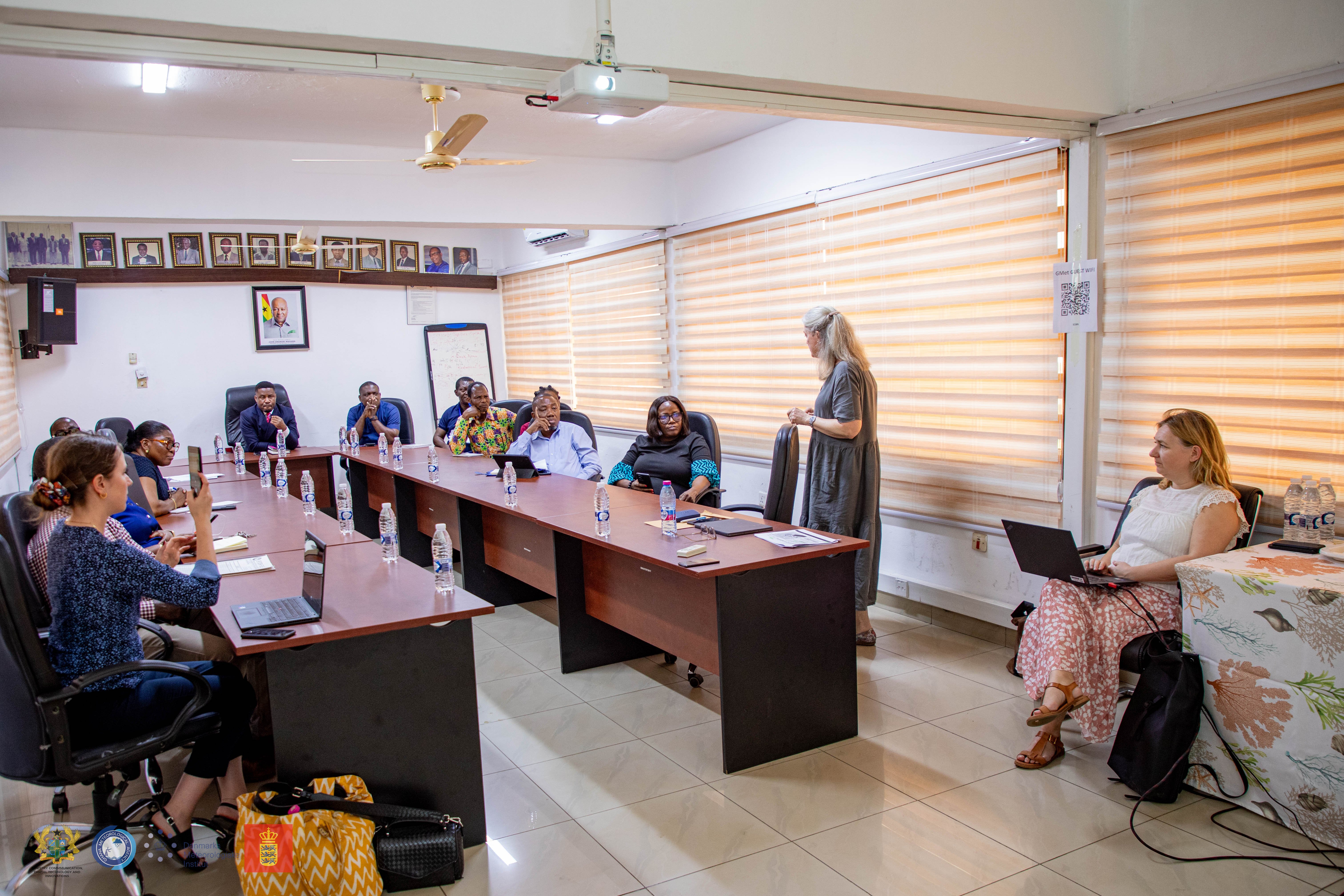
Leadership as a Shared Responsibility: DMI Director-General…

Minister of State for Climate Change Calls on Private Secto…

Meteorological Awareness Month 2025 Newsletter

Ghana Meteorological Agency Newsletter - September